1. Rafah · North Sinai · story stop, closed to visitors
Following the old coastal road from Gaza, the Holy Family crossed into Egypt at ancient Raphia, which Egypt's tourism ministry names as their first stop. Coptic tradition says the Child was about two years old and that a woman named Salome traveled with them.
Today: The old town center was demolished for the Gaza border buffer zone and is closed to visitors.
Matthew 2:13-15
2. Sheikh Zuweid · North Sinai · story stop, closed to visitors
Tradition holds that the family's coastal road from Rafah to Al-Arish ran past here. No Church list names it as a stop, so it is shown as a point on the way. The 6th-century Madaba mosaic map marks a town here called Betulion.
Today: A Bedouin town in a restricted security zone, closed to visitors. A late-antique mosaic found here in 1913 is now in a museum in Ismailia.
3. Al-Arish · North Sinai · story stop, closed to visitors
The Coptic Encyclopedia traces the family along the Mediterranean caravan road to Rhinocorura, the Roman border town that is today's Al-Arish. No particular event is remembered here; it was a waystation on the long walk west.
Today: The coastal capital of North Sinai. Under current restrictions it is not open to tour groups.
4. Al-Felusiyat · Zaranik, North Sinai · story stop, closed to visitors
The Coptic Church's own account takes the family from Gaza to the Zaranik area at Al-Felusiyat, about 37 km (23 miles) west of Al-Arish, before they entered Egypt at Al-Farama. Here stood Ostrakine, a Roman town that later had its own bishop.
Today: Ruins of Byzantine churches inside the Zaranik Protected Area, a bird reserve on Lake Bardawil; not open to tour groups at present.
5. Tell Al-Kalas · Lake Bardawil, North Sinai · story stop, closed to visitors
Tradition holds that the family's coastal road crossed this sandy headland on Lake Bardawil, the Mount Casius of ancient writers, between Al-Felusiyat and Al-Farama. No Church list names it, so it is shown as a point along the way.
Today: A remote headland on the Lake Bardawil shore with ancient remains but no visitor facilities, inside restricted North Sinai.
6. Al-Mohammadeyah · North Sinai · story stop, closed to visitors
Tradition holds that the family walked on along the shore past this coastal waystation, which some identify with ancient Gerrha, on the last stretch to Pelusium. It is a point inferred from the coast road rather than a stop named by the Church.
Today: A coastal archaeological area with no church or shrine; not open to visitors.
7. Al-Farama (Pelusium) · East of Port Said · story stop, closed to visitors
Pelusium, the fortified eastern gateway of Egypt, was the family's last station in Sinai; the Church's account has them enter Egypt here.
Today: Tell el-Farama, near Baloza east of Port Said: fortress walls, Roman baths, a theater and church ruins. Access is restricted.
8. Tell Basta · Zagazig, Sharqia
The Coptic Synaxarium, read on the feast of the Lord's entry into Egypt, begins the story at Basta, where the family drank from a spring whose water then healed every illness. The Church adds that the townspeople were unkind, so they moved on.
Today: An open-air archaeological site beside Zagazig, where granite blocks of the great temple of the goddess Bastet lie where they fell.
Isaiah 19:1
9. Mostorod · Qalyubia, north of Cairo
Here, the Church recounts, a spring rose for the family; Mary bathed the Child and washed his clothes, so the spot became known as Al-Mahamma, 'the bathing place'. The Church's account and the Synaxarium both bring the family back this way going home.
Today: The Church of the Virgin Mary, first built in 1185, with a spring that still flows; it is busiest during the Virgin's Fast in August.
10. Bilbeis · Sharqia
The family sheltered beneath a tree that people long called the Virgin Mary's Tree, and the Church says they passed through Bilbeis again on the way home.
Today: A busy market city in Sharqia, about 50 km (30 miles) northeast of Cairo.
11. Dakados · Mit Ghamr, Dakahlia
Local tradition in Mit Ghamr holds that the family rested here beside the Damietta branch of the Nile on their way north toward Samanoud. The main Church accounts do not name it, so it is shown as a cherished local memory.
Today: The village's Church of the Virgin Mary holds a popular August festival for the 'Virgin of Daqadus'.
12. Minyat Samanoud · Dakahlia
The Synaxarium brings the family from Basta to Minyat Samanoud, where they crossed the Damietta branch of the Nile westward to Samanoud. The Coptic Encyclopedia knows the village by its older name, Minyat Jinah.
Today: A farming village on the east bank of the Damietta branch, facing the town of Samanoud across the Nile.
13. Samanoud · Gharbia
Samanoud welcomed the family warmly, and Christ blessed its people. Mary is said to have kneaded dough in a large granite trough here, and the Lord blessed a well for the town. Local memory speaks of a stay of about two weeks.
Today: The Church of the Virgin Mary and St. Abanoub, built in 1841 and reopened after restoration in 2021, where the trough and well are shown.
14. Sakha · Kafr El Sheikh
The family reached Sakha tired and thirsty. The Synaxarium tells how the Child pressed his foot onto a rock that kept its print, so the place was named Pikha Isous, 'heel of Jesus'.
Today: The Church of the Virgin Mary keeps the footprint stone, found again in 1984 after being buried since medieval times.
15. Wadi El Natrun · The desert valley of the monasteries, Beheira
Crossing the Rosetta branch of the Nile, the family went west into this desert valley. The Synaxarium says the Virgin blessed it, knowing the monasteries that would one day fill it; the Church's account says Christ and his mother blessed it together.
Today: Four ancient, living monasteries welcome pilgrims, off the Cairo-Alexandria desert road.
- St. Bishoy Monastery: The valley's largest monastery: St. Bishoy's relics, the tomb of Pope Shenouda III, ancient churches and a fortified keep.
- The Syrian Monastery: Dedicated to the Virgin Mary and famous for its medieval wall paintings, about 500 m (a third of a mile) from St. Bishoy.
- St. Macarius Monastery: A working monastery with ancient churches and the relics of St. Macarius; visits are usually arranged in advance.
- Baramos Monastery: Probably the oldest of the four, founded around AD 335 and dedicated to the Virgin Mary.
16. Matariya · Mary's Tree, northeast Cairo
Near ancient Heliopolis the family rested under a sycamore, long called Mary's Tree, and Christ brought forth a spring where Mary washed his clothes. On the way home, the Synaxarium says, balsam grew beside the spring; its oil was used for the holy chrism.
Today: A walled garden keeps an old sycamore, planted in 1672 to replace the first tree, beside a chapel; the Heliopolis obelisk stands nearby.
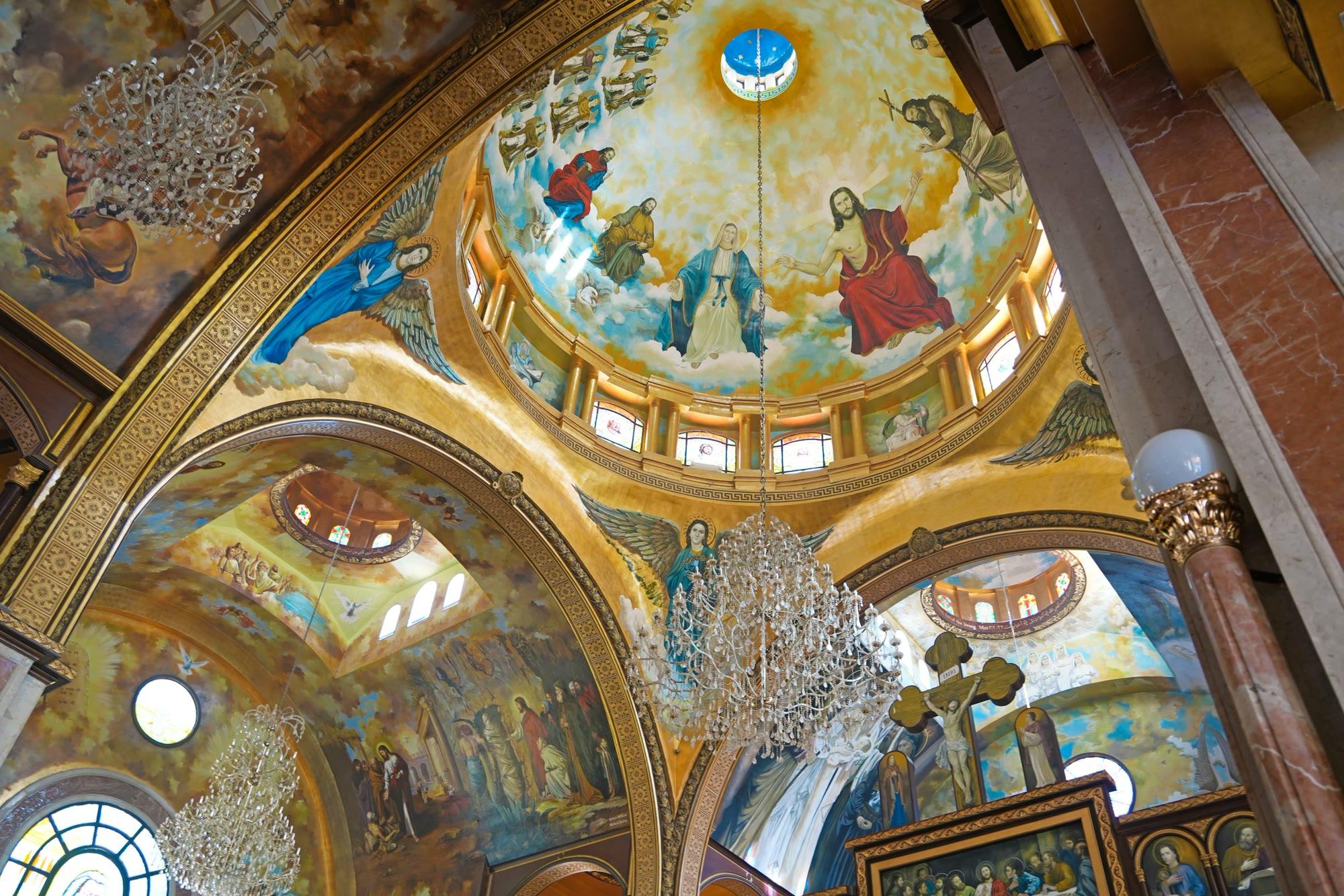
- Church of the Virgin Mary, Zeitoun: About 2 km (a mile) away. Tradition holds that the family stayed at or near this spot; the church is known worldwide for the apparitions of the Virgin reported above its domes from 1968 to 1971.
17. Haret Zuweila · Church of the Virgin, medieval Cairo
Walking south toward Babylon, the family passed through what is now this old quarter of Cairo, which the Coptic Encyclopedia names as their next station after Matariya. A well before the church's southern sanctuary is honored as water Christ blessed, believed to heal.
Today: A church probably dating from the 10th century, with a convent and an ebony-and-ivory screen; for a time the Coptic popes lived here.
18. Old Cairo · Abu Serga Church, Coptic Cairo
In Babylon, the Roman fortress town on the Nile, the family sheltered in a cave, now the crypt of Abu Serga Church. The Synaxarium says they rested there again on the way home, while the Church's account notes they did not stay long.
Today: A late 7th-century church in Coptic Cairo; its crypt is honored as the family's cave, though access is sometimes limited.
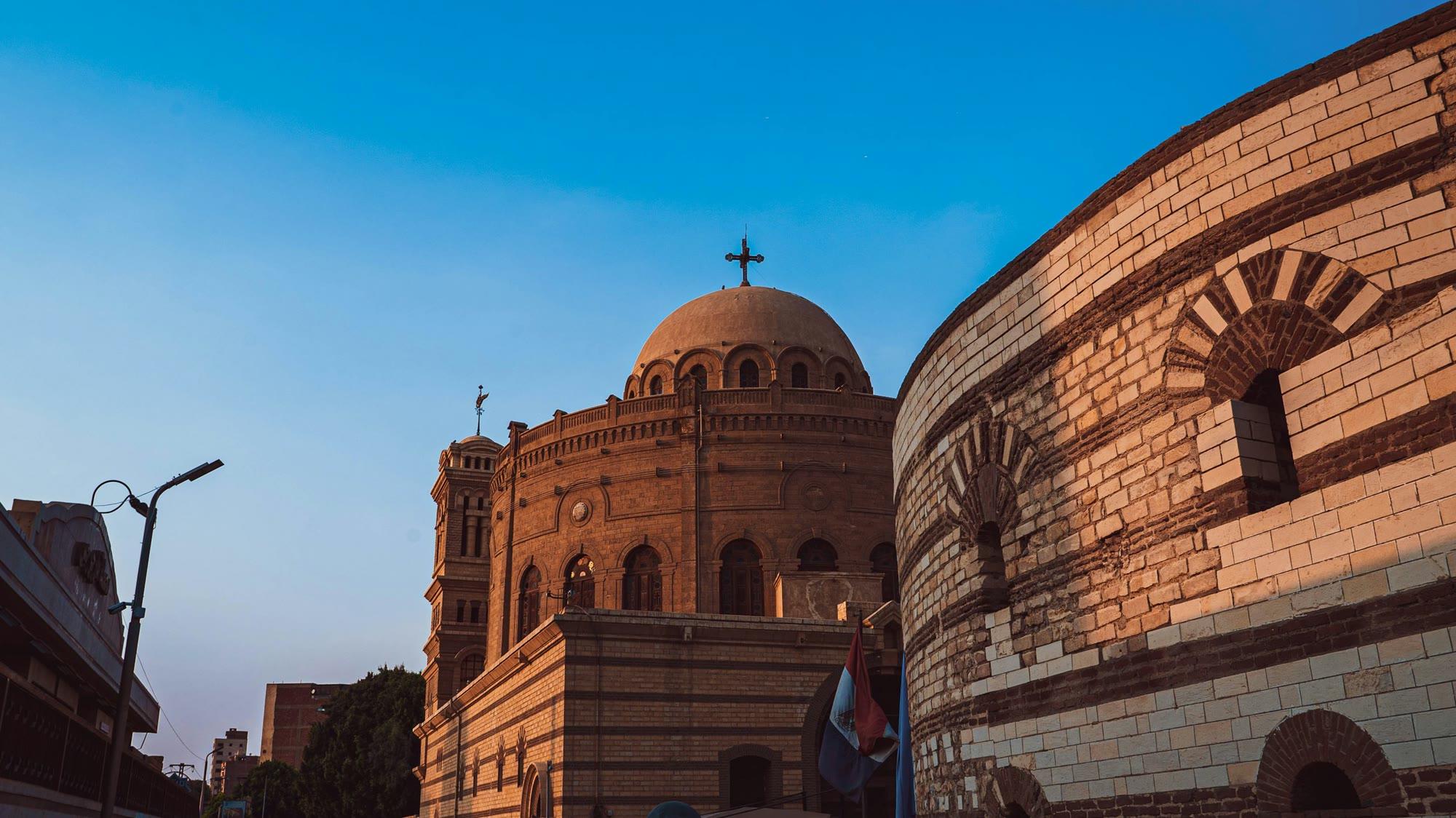
- The Hanging Church: A short walk from Abu Serga and counted among the Old Cairo places where the family stopped; Coptic Cairo's best-known church.
- Church of the Virgin, Babylon El-Darag: Coptic tradition counts it among the family's resting places; it keeps relics of St. Demiana and St. Simon the Tanner.
- The well of Ben Ezra: Local folklore says Mary drew water at the old well behind the Ben Ezra Synagogue to bathe the Child; a folk memory rather than a Church tradition.
19. Maadi · Church of the Virgin on the Nile, Cairo
Here the family went down to the Nile and set sail for Upper Egypt. The Church explains the name Maadi as the place of their 'crossing', and the stone steps they are believed to have used are still shown.
Today: A riverside Church of the Virgin with old steps down to the Nile; a Bible found floating here in 1976 lay open at Isaiah 19:25.
Isaiah 19:25
20. Memphis · Mit Rahina, Giza
Crossing from Maadi to the west bank, the family passed Memphis, Egypt's ancient capital, on the road into Upper Egypt. The Coptic Encyclopedia and Egypt's tourism ministry both mark this crossing, but no church recalls a stay here.
Today: The Mit Rahina open-air museum, with a colossal statue of Ramesses II; there is no Holy Family church or shrine.
21. Deir El-Garnus · Near Maghagha, Minya
Heading south to Hermopolis, the family stopped here, and a monastery later grew up on the spot. Legend says the Child opened a well whose water cured every disease and foretold the height of the Nile flood; the Church says the well remains.
Today: The Church of the Virgin Mary, built around 1870 beside remains of an older church, keeps the well; thousands gather for a late-August feast.
22. Al-Bahnasa · Minya
The Church's account says the family passed a spot just east of Al-Bahnasa called Abai Issus, 'House of Jesus', where the village of Sandafa stands today. Local tradition in Al-Bahnasa also points to a tree it calls Mary's Tree.
Today: The ruins of Oxyrhynchus, the Greco-Roman city whose ancient rubbish mounds yielded thousands of papyri, among them some of the earliest Gospel fragments.
23. Gebel El Teir · Monastery of the Virgin, near Samalut, Minya
Near Samalut the family crossed to the east bank and sheltered in a cave high in the cliff. Tradition says that when a rock broke loose above their boat, the Child raised his hand and held it back, leaving the print of his palm.
Today: A clifftop Church of the Virgin overlooking the Nile, built around the family's cave; tradition says Empress Helena founded it in AD 328.
24. Al-Ashmunein · Hermopolis, near Mallawi, Minya
The family crossed to the west bank and stayed a few days in Hermopolis. Around AD 400 the monk Palladius saw the temple whose idols fell on their faces as the Savior entered. Some accounts add a second visit on the way home.
Today: The Hermopolis ruins near Mallawi: standing granite columns of a 5th-century basilica and giant statues of baboons sacred to Thoth.
Isaiah 19:1
25. Dayrut Al-Sharif · Assiut
Heading south toward Qusqam, the family stopped at Dayrut, which the Church lists among its stations. Tradition places the visit in this village, known in Coptic as Terot Sarapamon and home to the old Monastery of St. Sarapamon.
Today: A west-bank village about 2 km (a mile) north of Dairut town, with the Monastery of St. Sarapamon.
26. Meir & Al-Qusiya · Assiut
The people of Al-Qusiya drove the family away, but at Meir, a short way to the west, they were received with honor and Christ blessed the village, the Church's account says. From here they went on to Mount Qusqam.
Today: A farming village about 7 km (4 miles) west of Al-Qusiya; the ancient rock tombs of Meir, with fine reliefs, lie 5 km (3 miles) southwest.
27. Al-Muharraq Monastery · Mount Qusqam, Assiut
Here the family made their longest stay, six months and ten days, in a cave the Church calls the world's first church. Copts revere its altar as the one Isaiah foretold; by one tradition the angel told Joseph here to return.
Today: The Monastery of the Virgin, which Copts call 'the second Jerusalem'; its ancient Church of al-Adra keeps an altar stone dated AD 747.
Isaiah 19:19; Matthew 2:19-20
28. Drunka · Monastery of the Virgin, Mount Assiut
From Qusqam the family went south to the mountain of Assiut, the farthest point of their journey, and sheltered in an old cave in the cliff. There, says the Church, the angel came to Joseph in a dream and told him to return home.
Today: The Monastery of the Virgin, high on the cliffs 10 km (6 miles) from Assiut, around the cave church; vast crowds come for its August 7-21 feast.
Matthew 2:19-21